How much does a Tanzania safari cost?
For the luxury, tailor-made safaris we arrange at Tanzania Safari Company, approximately £1,000 per person per night on safari is a useful starting budget. For a luxury Zanzibar beach stay, allow approximately £500 per person per night.
Using those benchmarks, six nights on safari comes to around £6,000 per person, or seven nights around £7,000. Add five nights in Zanzibar to a six-night safari and the accommodation-and-safari planning subtotal becomes approximately £8,500 per person, before separately priced travel and extras.
These are planning guides, not fixed prices or an average for every safari sold in Tanzania. Season, camp choice, private guiding and the route can move the total substantially. Domestic flights, transfers and arrival nights also need to be costed before you have a complete holiday price.
Cheaper safaris exist, including basic camping and group departures. We specialise in luxury, tailor-made travel and do not arrange basic camping safaris. The useful question here is what a well-planned luxury trip costs, and what you receive for your money.
I have been arranging Tanzania travel since 2011. My starting point is to understand the experience someone wants, then build a sensible route and explain its costs. A headline daily rate cannot do that on its own.
A practical Tanzania safari pricing guide
The table below uses our indicative benchmarks to show how a budget builds. All figures are in GBP, for two adults sharing one room or tent, with the couple’s total shown separately.
There is no specific travel month or priced departure behind these examples. They are initial allowances for dates outside festive peaks, subject to camp-specific seasonal rates; they do not assume a low-season discount. Peak migration periods, premium suites and exclusive-use arrangements may require more.
| Trip | Calculation per person | Illustrative subtotal per person | Illustrative subtotal for two |
|---|---|---|---|
| Four nights on safari | 4 × £1,000 | £4,000 | £8,000 |
| Six nights on safari | 6 × £1,000 | £6,000 | £12,000 |
| Seven nights on safari | 7 × £1,000 | £7,000 | £14,000 |
| Six safari nights + five Zanzibar nights | £6,000 + £2,500 | £8,500 | £17,000 |
| Seven safari nights + six Zanzibar nights | £7,000 + £3,000 | £10,000 | £20,000 |
Safari allowance: accommodation, meals, standard scheduled game-viewing activities and applicable park, concession and conservation fees. The activity basis may be a private driving safari or shared camp activities and must be specified in the quote; the allowance does not promise a private vehicle at every camp.
Zanzibar allowance: accommodation and a provisional meal allowance. The actual hotel’s board basis, drinks and activities must be confirmed; do not assume all-inclusive.
Excluded from these illustrative subtotals: international and domestic flights, airport and inter-camp transfers, arrival or departure hotel nights, private-vehicle supplements on camp-based stays, premium activities, visas, insurance, separately payable local levies, tips and personal spending. Some actual packages bundle flights or transfers; those inclusions must be checked rather than added twice.
These are therefore indicative trip subtotals, not complete payable holiday totals. We price the remaining arrangements against your dates and route rather than inventing a universal transport allowance.
Tanzania safari cost per day versus per night
Our safari benchmark is approximately £1,000 per person per night, rather than a guaranteed price for each calendar day. A six-night safari normally spans seven calendar days, and arrival and departure days may contain very different amounts of game viewing.
Compare the actual nights, usable safari time and inclusions. Dividing a package by its advertised number of days can make a transfer-heavy itinerary look better value than it is.
Why travel bloggers are not always the best safari pricing advisers
A travel blogger can give a useful account of a trip: what they paid, where they stayed and what they enjoyed. That is valuable evidence about that particular holiday.
It does not necessarily establish what you should pay for yours.
Someone who has visited Tanzania once, or a handful of times, may have little basis for comparing different ground operators, guiding standards, camp locations and luxury travel arrangements. Obtaining several quotes is useful, but it does not prove that the underlying services are equivalent.
Reporting on one trip and advising on a substantial safari investment require different knowledge.
A career specialist works across properties, operators, seasons and itinerary styles. Specialists who have arranged hundreds or thousands of clients’ safaris can draw on a breadth of feedback that a single traveller cannot. The important distinction is the depth and relevance of that experience; being a blogger or a travel agent is not itself proof of expertise.
Some bloggers have substantial destination knowledge. Their work deserves to be assessed on that basis. My concern is with confident, market-wide advice built on a narrow sample, particularly claims that one booking method always saves money.
Look at how recommendations are funded
Hosted trips, discounted stays and affiliate commissions can influence which experiences appear in travel content. They do not automatically invalidate the advice, but readers should understand the commercial context and whether a reported price was available to an ordinary paying guest.
Specialists also have commercial relationships. Apply the same scrutiny to us: ask why a property is recommended, what alternatives were considered and what the total includes. A convincing recommendation should stand up to those questions.
Is it cheaper to book a Tanzania safari locally?
Sometimes, but booking directly with a Tanzanian operator does not automatically produce a lower price. This is particularly important for luxury safaris, where supplier pricing and the combination of camps can matter more than the booking company’s address.
There are excellent Tanzanian operators and excellent overseas specialists. Either can offer good value, and either can produce an expensive or poorly designed itinerary. Location alone tells you little about expertise, service or pricing.
How commissions and trade rates work
Safari suppliers may sell at a published retail rate and pay an agreed commission to a booking specialist. Alternatively, they may provide a net trade rate, to which the specialist adds a margin when building the holiday.
In the first arrangement, the commission can sit within the retail price rather than being an additional charge to the traveller. In the second, the final price depends on the net rate and margin. Neither arrangement proves that booking direct will be cheaper.
For illustration only, a supplier could sell a service directly for £1,000, or a specialist could sell it for the same £1,000 and receive an agreed commission from the supplier. This is an explanation of the mechanism, not a statement of our commission on any booking.
Specialist advice therefore does not necessarily add to your price. It can be funded through the supplier’s distribution arrangements.
Where a specialist can save money
Negotiated rates, longer-stay offers, honeymoon terms, camp combinations and included transfers can make a specialist’s total equal to or better than a direct booking. Some offers are also available directly; the value lies in identifying and correctly applying the right combination, not claiming exclusive access to every discount.
Itinerary design matters too. Removing an unnecessary overnight stop, avoiding a backtracking transfer or combining compatible camps can reduce costs while improving the holiday.
A direct local operator may still be cheaper, especially when comparing a straightforward driving safari that it operates itself. An overseas company may charge more for an equivalent trip. Equally, two quotes that sound similar may contain very different camps, vehicles and guiding arrangements.
The only useful test is to compare the complete price for genuinely equivalent arrangements, including booking terms, payment charges and support.
Why are Tanzania safaris expensive?
A safari combines accommodation with a guided wildlife experience and the logistics required to deliver both in remote places. Several costs sit behind the room rate.
Season and demand
Popular dry-season dates, migration-focused stays and Christmas and New Year can command premium rates. Calving-season camps can also be in high demand; January and February should not automatically be treated as cheap alternatives.
Green-season travel can offer attractive accommodation rates, but rainfall, access, camp closures and the activities available need to be considered. A saving is useful only if the trip still suits your priorities.
Accommodation and location
“Luxury tented camp” is not a consistent standard. It can describe very different levels of space, service, privacy, food and guiding.
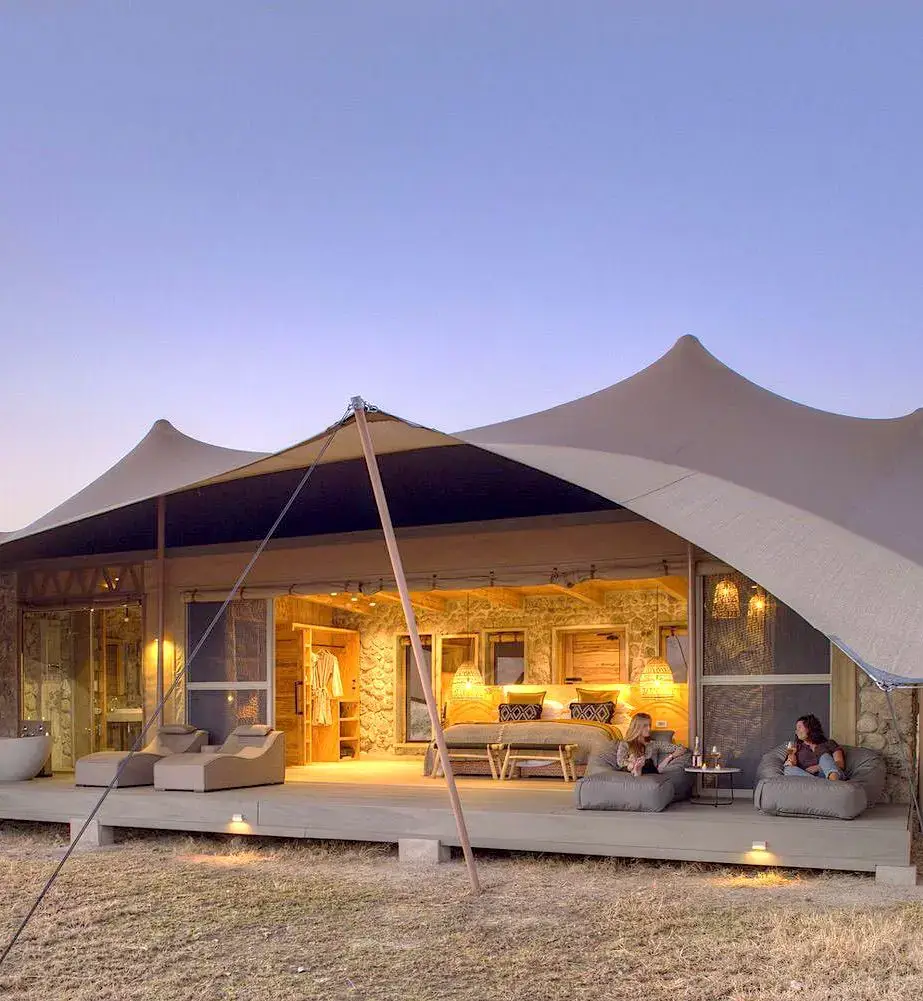
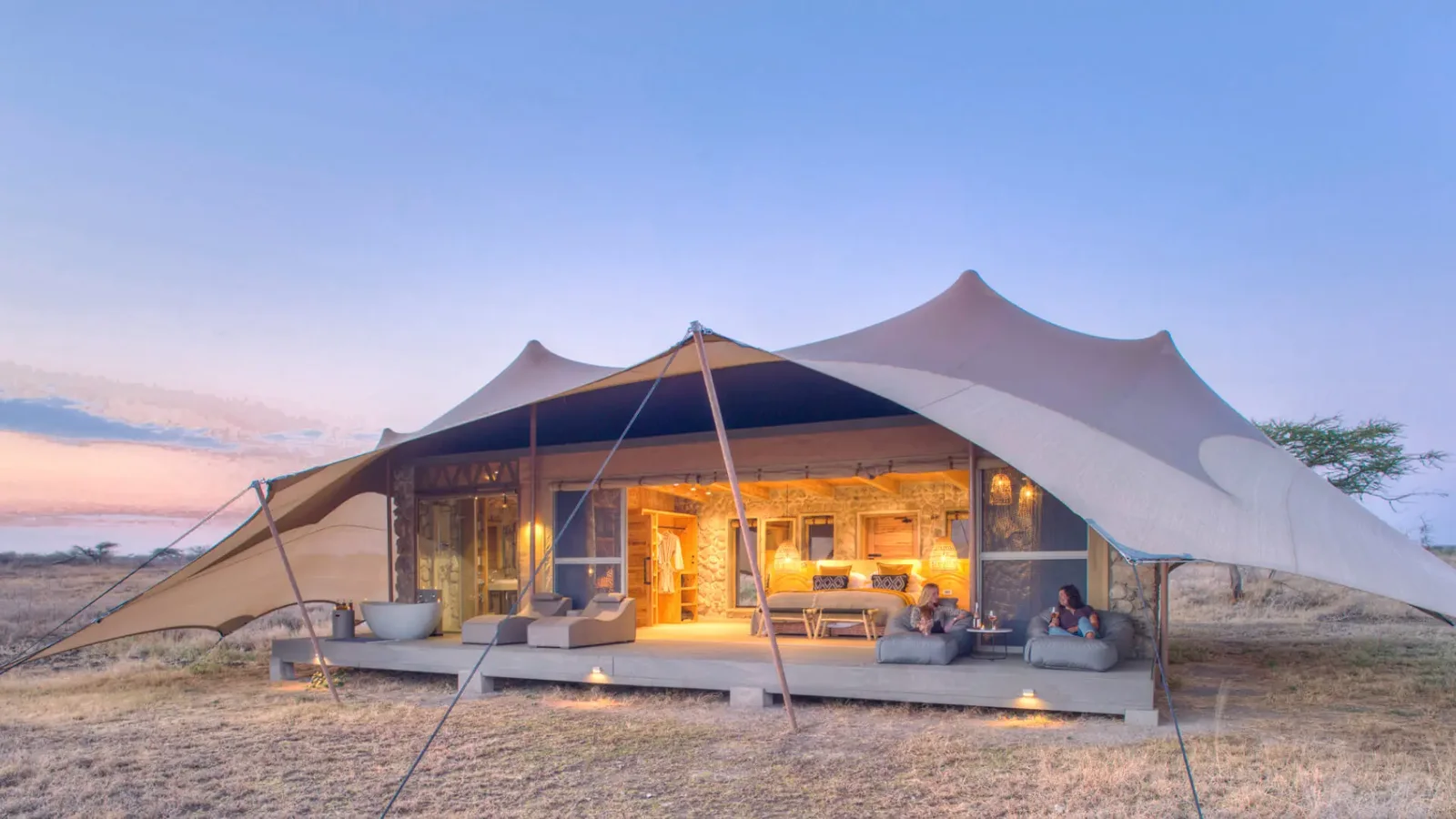
Basic camping involves simple camping equipment and facilities. Luxury tented accommodation can offer proper beds, substantial en-suite bathrooms and highly attentive service. Canvas is an architectural choice, not a budget category. A lodge’s solid walls do not automatically make it more luxurious or more suitable for every family.
Location can be more valuable than another room feature. A cheaper camp in a different part of the Serengeti may be a poor base for the wildlife experience you want in your travel month. Money saved on accommodation can be paid back in long drives.
Park, concession and conservation fees
Protected-area entry, overnight and concession charges can form a meaningful part of the bill. Different authorities and areas have different charging structures, and certain activities or vehicle movements carry additional fees.
Ask whether the quote includes every applicable fee and tax. A headline room rate excluding protected-area charges is not comparable with a fully costed safari package.
Guiding and vehicles
A good guide contributes far more than wildlife sightings. Knowledge, communication, judgement and an understanding of your interests shape each day.
Vehicle maintenance, seating, visibility, shade and charging facilities also matter. Ask how many guests will travel together and whether the vehicle is suitable for the conditions. A photograph of a safari vehicle tells you little about its maintenance or the support available if it breaks down.
Flights, transfers and operational support
Remote camps require staff, food, fuel and equipment to be supplied over considerable distances. Moving guests between them adds another layer of logistics.
Reliable coordination matters when a flight changes or a connection becomes difficult. Find out who takes responsibility for resolving problems and how to reach them during your trip. Those arrangements may be less visible than a swimming pool, but they affect the holiday just as directly.
Private driving safari or fly-in itinerary: which offers better value?
Private driving safaris
A private driving safari can work particularly well when linking northern Tanzania’s parks. Travelling with the same guide offers continuity, and a family or group can share the vehicle’s fixed costs.
For two travellers, those costs are divided between fewer people, so a private Tanzania safari can cost more per person than a similar trip for four. That does not mean the entire holiday halves in price when the party doubles: accommodation and many fees remain charged per person.
Driving offers value when the route is coherent and the journeys form an enjoyable part of it. It loses value when too many distant stops leave you spending much of the holiday in transit.
Fly-in safaris
Flying can remove a long road transfer and allow more time in the area you actually want to explore. It can be especially useful for a focused northern Serengeti stay or a combination of remote parks.
Scheduled light-aircraft flights may involve intermediate stops and baggage restrictions. They also do not automatically include private guiding once you reach camp.
A combined approach can work well: drive through suitable northern stops, then fly out of the Serengeti. I would judge the flight against the road journey it replaces, the time available and the overall cost.
There is no universal seven-day minimum for reaching the northern Serengeti. A focused fly-in stay can reach it much sooner. Whether a short trip is worthwhile depends on the connections and how much time you then have on safari.
Northern versus southern Tanzania: compare the whole experience
Northern Tanzania offers combinations of the Serengeti, Ngorongoro and Tarangire, with options for driving, flying or both. Costs vary with the exact route, season and accommodation; a northern circuit is not one standard product.
Nyerere and Ruaha offer a different style of safari, often appealing to people who want quieter settings and more time in fewer places. Depending on the camp, location and conditions, activities can include walking and, in Nyerere, boating alongside game drives.
Southern Tanzania can offer excellent value, but it is not automatically cheaper. Remote access and inter-camp flights can offset accommodation savings. Nor should walking and boating be assumed to be available at every camp or throughout every season.
Choose between north and south for the wildlife, landscapes and rhythm you want, then compare complete itineraries.
Private versus shared vehicles and activities
“Tailor-made safari” means the itinerary is arranged around you. It does not necessarily mean every activity is private.
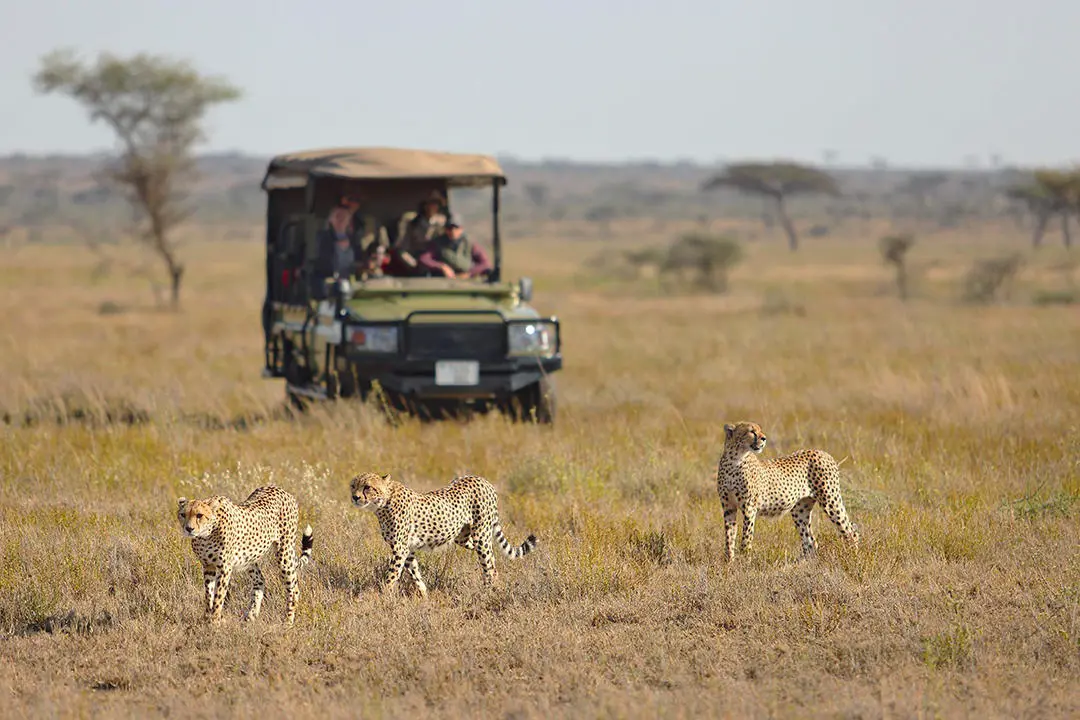
At a fly-in camp, the standard package may include game drives shared with other guests. A private vehicle can carry a supplement and should be reserved in advance. A private road safari may include your own vehicle between parks, while a boat excursion or another specialist activity remains shared.
Shared activities can be very good value when guest numbers are sensible and interests align. Private guiding is especially useful for families, keen photographers or anyone who wants control over timings. Ask for the arrangement at each stop in writing.
When a cheaper safari quote involves a real compromise
A lower price can be excellent value. The task is to understand what changed to achieve it.
| Apparent saving | What to check |
|---|---|
| A less expensive camp “near the Serengeti” | Its exact location, access arrangements and driving time to the areas you want to explore. |
| A cheaper “private safari” | Whether privacy applies to transfers, game drives or both, and whether it continues at every camp. |
| More parks for the same price | How many nights are spent in each place and how much of each day is travel. |
| A lower accommodation rate | Whether meals, drinks, activities, fees and taxes have been excluded. |
| A substantial vehicle saving | Guest numbers, vehicle condition, guide arrangements and breakdown support. |
| A cheaper Zanzibar extension | Room category, meal plan, beach characteristics and whether transfers and local charges are included. |
A higher price does not automatically guarantee quality. An expensive camp in the wrong location can be a worse choice than a simpler, well-run camp where you want to be.
Additional costs to budget for
International flights: price these for your actual dates, cabin and routing. Arriving at one airport and departing from another can avoid backtracking, but compare the full airfare and ground arrangements.
Domestic travel: confirm scheduled or charter flights, airport transfers, airstrip transfers and any extra hotel nights required by connections.
Visas and entry requirements: costs depend on nationality and visa category. Use the official application route and check the requirements for your passport.
Insurance: budget for suitable personal travel insurance and any mandatory inbound cover required by the Tanzanian authorities. Check the current rules for your first point of entry, including Zanzibar.
Tipping: allow separately for guides and camp teams. Ask for guidance appropriate to your itinerary, distinguishing a tip per guest from one per vehicle or travelling party.
Optional activities and personal spending: balloon flights, spa treatments, premium drinks, shopping and some private experiences may be additional. Beach-hotel meal plans, laundry and local accommodation levies also need checking.
How to improve value without losing the quality of the trip
I would start with the route and timing before reducing the quality of guiding or choosing a poorly located camp.
- Consider alternative dates. A modest shift can change rates, but check conditions in the specific parks and on Zanzibar.
- Spend longer in fewer places. Fewer transfers can reduce costs and leave more time for wildlife and relaxation.
- Compare camp combinations. A longer-stay or portfolio offer may improve the complete price; it should still produce a varied, suitable itinerary.
- Prioritise the features you will use. Exceptional guiding or a better location may matter more than a private pool.
- Choose privacy selectively. Reserve a private vehicle where it changes your experience, rather than assuming every shared activity is a compromise.
- Balance safari and beach nights. At our planning benchmarks, a Zanzibar night costs less than a safari night, although connections and the overall route still matter.
Adding nights does not automatically reduce the daily price. Accommodation and protected-area fees continue, and any longer-stay saving depends on the supplier’s terms.
A checklist for comparing Tanzania safari quotations
Before choosing between proposals, make sure you can answer these questions:
- Are the dates, number of nights and number of travellers identical?
- Are the named camps, room categories and occupancy arrangements confirmed, or merely suggested?
- Where is each camp, and is that location suitable for the month and your wildlife priorities?
- How much time is spent travelling, and how much usable safari time remains?
- Which vehicles, guides and activities are private, and which are shared?
- What meals, drinks, laundry and activities are included at each property?
- Are all park, concession, conservation, vehicle and applicable tax charges included?
- Are flights, baggage allowances, airport transfers and airstrip transfers clearly specified?
- What remains payable locally, and are currency or payment charges relevant?
- Who is responsible for the whole booking and for assistance during the trip?
- What are the deposit, cancellation, amendment and financial-protection arrangements?
If one quote is substantially cheaper, ask the company to explain the difference. A clear answer is more useful than another adjective describing the camp.
Tanzania safari cost FAQs
What does a luxury Tanzania safari cost for two people?
At our indicative £1,000 per person per night benchmark, six safari nights come to approximately £12,000 for two adults sharing. This is a planning subtotal; separately priced transport, arrival nights and personal extras need adding as detailed above.
How much does a Tanzania safari and Zanzibar holiday cost?
Six safari nights and five Zanzibar nights give an illustrative subtotal of approximately £8,500 per person using our benchmarks. The final holiday price depends on dates, properties, meal plans, flights, transfers and other inclusions.
Is a private safari always more expensive?
Exclusive guiding usually carries a cost, but sharing a private vehicle among family or friends can offer good value per person. Compare the complete itinerary and establish exactly which services are private.
Are tented camps cheaper than lodges?
Not necessarily. Luxury tented camps can be among the most expensive accommodation options. Location, service, guiding and facilities tell you more than whether the walls are canvas.
Will booking directly with a local operator save money?
It may, but there is no automatic saving. Compare equivalent accommodation, guiding, vehicles, transport, fees and booking terms. Supplier commissions, trade rates and itinerary offers can allow specialists to match or improve on direct pricing.
Is a Tanzania safari worth the money?
It can be, when the route, guiding and accommodation deliver the experience you want. I would rather recommend a focused safari with time to enjoy it than an expensive checklist of parks. Value comes from how well the holiday fits you and how reliably it is delivered.
Plan your Tanzania safari with Ben and the team
If you are considering a Tanzania safari, tell us when you would like to travel, who is coming and the budget you feel comfortable with. I can help you understand what is realistic and where spending more, or less, will make a meaningful difference.
At Tanzania Safari Company, we build luxury, tailor-made safaris around the experience you want, with clear pricing and an explanation of the choices behind it. Speak to me and the team to start planning yours.